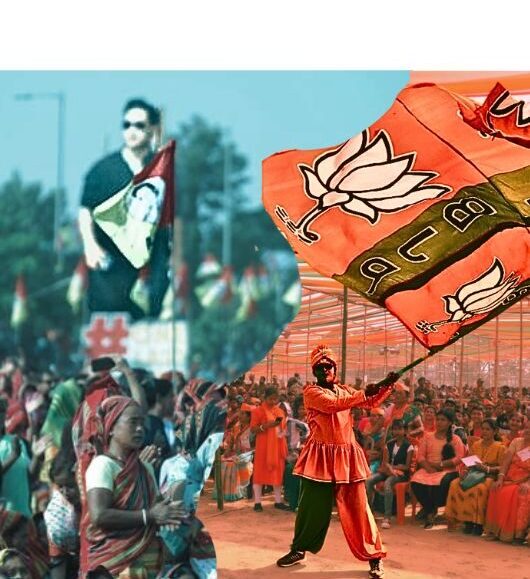
On 20th November, reports of violent clashes between members of the Bharatiya Janata Party (BJP) and the Tipra Mota Party (TMP) and arson came from Tripura. More specifically, from Khumulung town, which also serves as the headquarters of the Tripura Tribal Autonomous District Council (TTADC). It is only the recent incident in what has been increasingly becoming normal. On October 23rd, another major violence was reported from the Surma bloc of Dhalai district of the state. Following the Bihar election results, reports have also emerged from various parts of the state of attacks on CPI(M) party offices and members. While Tripura is no stranger to political violence, what is interesting this time around is the fact that two parties that are engaging in violence are in fact allies in the government. The BJP and the TMP have 32 and 13 MLAs, respectively, and together form the majority in the 60-member Vidhan Sabha (Legislative Assembly). The recent series of violence is indicative of more fundamental contradictions within the alliance, which can be understood only through a contextual grasp of politics and society in the state. The alliance is more than a manifestation of ‘realpolitik’ and is revealing of elemental fault lines in the politics and society of the state.
The TMP and the evolving contours of tribal assertion
The Tipra Motha Party (TMP) was formed in 2021, making it the latest entrant into Tripura’s electoral landscape. Its founder, Pradyot Bikram Manikya, initially conceived the organization as an “apolitical” social platform aimed at safeguarding the rights and interests of the state’s indigenous communities. He soon emerged as a vocal critic of the Citizenship Amendment Act (2019), arguing that the legislation was fundamentally inimical to the demographic, cultural, and political interests of Tripura’s indigenous population.
TMP contested its first major election in 2021, the Tripura Tribal Areas Autonomous District Council (TTADC) elections, and registered a landslide victory, winning 16 of the 23 seats it contested. In the 2023 legislative assembly elections, the party secured 16 seats, an unprecedented achievement for a tribal-based political party in the state. Notably, the Left, led by the Communist Party of India (Marxist), managed to win only 11 seats. This result not only established TMP as the main opposition party but also signalled the deepening decline of the CPI(M), which had lost state power in 2018 and was now displaced even as the main opposition. TMP’s electoral success lay in its ability to consolidate tribal votes on an unprecedented scale, effectively dislodging the Left from its long-standing dominance over tribal constituencies.
TMP entered the political arena with a promise of development, coupled with a new language of assertion through constitutional means. Rejecting the traditional Left-Right binary, the party articulated its guiding philosophy as “Poila jati, ulo party” (community first, party later). This marked the emergence of a new idiom of tribal assertion grounded in constitutionalism and democratic negotiation. In this sense, TMP represents a departure from earlier phases of tribal assertion in Tripura, which were characterised, first, by revolutionary violence and, later, by ethnic nationalist militancy. The armed uprising of the Ganamukti Parishad (GMP) against the monarchy constituted the first phase in the post-independence period, while the second phase was marked by militant violence by ethnic nationalist outfits such as the National Liberation Front of Tripura (NLFT) and the All-Tripura Tiger Force (ATTF).
While these phases may outwardly appear distinct, they share a common core, representing a language and a method of assertion and negotiation with the state employed by the historically marginalized tribal community. Seen from this perspective, the contemporary phase under TMP is not a rupture but a continuity in indigenous peoples’ assertion in the state.
At the same time, the present phase marks a significant transformation in both form and leadership. History appears to have come full circle, with a member of the former royal family now leading a movement rooted in democratic and constitutional politics. Pradyot Bikram Manikya embodies a modern mode of leadership- outspoken, sophisticated, confident, and articulate. His appeal extends beyond the tribal hinterlands to the national political and discursive arena. He speaks a language that is legible to national elites while simultaneously forging solidarities with tribal political leaders across the Northeast. Projecting himself as socially liberal and politically pragmatic, he has come to define a new age of tribal assertion in Tripura. In terms of political appeal, articulation, and symbolic authority, contemporary tribal leaders from other political formations in the state do not come close to matching his stature.
The state presents a rare case in which the indigenous population, once a majority, has been reduced to a demographic minority. This experience is often cited nationally, especially in comparison with Assam, as a cautionary tale of unchecked migration. Yet, a crucial distinction separates Tripura from the dominant national narrative: the majority of migrants who settled in the state are Hindu, rather than the feared Bangladeshi (Miya) Muslim. This divergence produces a fundamental contradiction between the TMP and the BJP.
An alliance of contradictions
TMP’s emergence is better understood as a challenge to and a front against the Left, specifically the CPI(M), although its stated objective is the welfare and political empowerment of the indigenous people of Tripura. Since the advent of democratic politics in Tripura, the Left had remained the dominant political force in the state’s tribal areas. Even explicitly tribal nationalist parties such as the INPT, IPFT, and TNV were unable to replicate the CPI(M)’s electoral success in either the Legislative Assembly or the Tripura Tribal Areas Autonomous District Council (TTADC) elections. The Congress, by contrast, was limited to the semi-urban and urban, non-tribal constituencies.
The exceptional popularity of the CPI(M) among the tribal population can be traced back to the period of the monarchy. The Ganamukti Parishad (GMP) and its armed struggle for democracy and justice constituted the foundational basis upon which the Left consolidated its legitimacy and support among Tripura’s indigenous communities. Following the formation of the TTADC, the CPI(M) consistently dominated ADC elections. Much like the BJP inherited the Congress’s voter base in the state, the TMP has, to a significant extent, mobilized and absorbed the Left’s erstwhile support among the tribal electorate.
The TMP’s voter base is primarily drawn from the indigenous population, which constitutes roughly 30 percent of Tripura’s total population. Securing rights, autonomy, and privileges for this demographic necessarily entails negotiation with the remaining 70 per cent, predominantly non-tribal, Bengali population. This structural imbalance creates inherent tensions, particularly because the BJP positions itself as the protector of caste Hindu interests. While this is not a zero-sum game, the problem is exacerbated by the increasingly assertive, albeit constitutional, political language adopted by the TMP under Pradyot Bikram Manikya, on the one hand, and an unapologetically confident right-wing, on the other. An alliance formed not on shared foundational principles but on an ad hoc anti-Left convergence is bound to confront internal contradictions. The stalemate over the implementation and rectification of the Tipra Accord, along with continuing instances of grassroots violence, reflects this underlying tension.
The insider–outsider discourse, for instance, particularly around the alleged illegal influx of migrants from Bangladesh, has acquired a national resonance in recent years. However, this discourse has long been a central part of Tripura’s political and social landscape. The state presents a rare case in which the indigenous population, once a majority, has been reduced to a demographic minority. This experience is often cited nationally, especially in comparison with Assam, as a cautionary tale of unchecked migration. Yet, a crucial distinction separates Tripura from the dominant national narrative: the majority of migrants who settled in the state are Hindu, rather than the feared Bangladeshi (Miya) Muslim. This divergence produces a fundamental contradiction between the TMP and the BJP. While the national right seeks to frame migration largely through a communal-religious lens and remains relatively accommodating toward Hindu migrants, such a framing does not resonate in Tripura. Political polarization in the state has historically occurred along tribal versus non-tribal lines, rather than along religious lines. Consequently, the BJP’s core support base in Tripura, the Bengali Hindu population, simultaneously constitutes the “outsider” figure within indigenous political imaginaries.
The contradiction becomes even more pronounced when the TMP’s position on the National Register of Citizens (NRC) is considered. The TMP has repeatedly called for the implementation of the NRC in Tripura, framing it as a necessary mechanism to safeguard indigenous rights and demographic security. Paradoxically, it is the state unit of the BJP that has resisted such demands. This position appears counterintuitive, given that the national BJP has consistently foregrounded the politics of the NRC and the figure of the ‘infiltrator’ as central tools for mobilising support and confronting political opponents.
This divergence once again underscores the limits of ideological coherence within the TMP-BJP alliance. While the national BJP deploys the NRC selectively as part of a broader communal-nationalist project, its implementation in Tripura would directly implicate the party’s core support base, the Bengali Hindu population. Consequently, the NRC ceases to be a convenient instrument of political mobilisation and instead becomes a potential source of political risk.
This contradiction is further deepened by TMP’s insistence on projecting itself as a non-communal party committed to the Constitution of India and its secular values. While the alliance between the TMP and the BJP may find common ground on certain tactical or electoral issues, they ultimately represent two distinct and competing nationalist imaginations. As a result, convergence is necessarily limited, and collision- both ideological and political remains structurally inevitable.
Conclusion
The conflicts unfolding in Tripura cannot be dismissed as isolated incidents or outcomes of minor grassroots disagreements. Rather, they are symptomatic of deeper structural contradictions embedded within the state’s political landscape, particularly in the TMP-BJP alliance. The uneasy, contradictory alliance between divergent nationalist imaginations, the unresolved tensions between indigenous assertion and demographic realities, and the disjuncture between national ideological frameworks and regional political histories collectively produce a condition of persistent cycles of political violence. The rationale of neither left nor right, once stripped of its veneer of neutral purity, invariably exposes itself as converging with the political and economic right. The real interests of the real peoples will always dictate what happens on the ground.