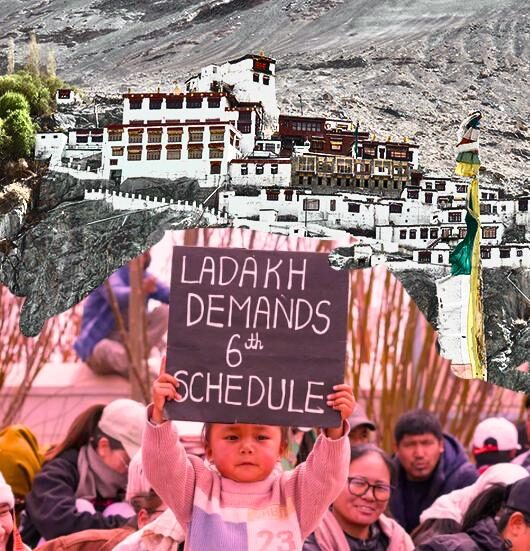
The images of violence on the 24th of September 2025 showing protestors torching the local BJP office and the Ladakh Autonomous Hill Development Council (LAHDC) Leh complex and the response by the security forces who fired which led to the unfortunate demise of four individuals shocked the local populace and the national conscience alike, as the region is seldom associated with violence. Acute unemployment amongst the youth since the region was made a Union Territory in 2019 ignited the “spark” among agitators as the President of Ladakh Buddhist Association and Apex body co-chairman Tsering Dorjay Lakrook put in an interview with the Hindustan times on 2nd November 2025. The mainstream national media amplified the government’s version of the spark as they wrongly circulated the images of a local Congress councillor leading the mob which led to a defamation suit, the deeper reasons are explored here.
The bifurcation of the state of Jammu and Kashmir saw varied responses from different regions of the state. In Ladakh, the traditional rift along religious and regional lines among Buddhist dominated Leh and Muslim dominated Kargil came to the fore once again. Traditionally, on all important political questions, Leh and Kargil have been at loggerheads. Leh supported the call for UT whereas Kargil opposed it. Kargil also opposed the formation of LAHDC initially. These differences were sometimes fueled and used by political elites in Kashmir for electoral benefits. However, events which led to mass gatherings demanding statehood made way for differences and faultlines to come down to a minimum common program as concerns that effect the region grew.
Not only unemployment, the immediate trigger, the deeper question has always been about the existence of Ladakh. The near possibility of unregulated industrialization/corporatization/ demographic change has become a reality in the absence of any constitutional safeguards. This immediate concern brought the leaders and people from the two districts together on a single platform. It was not just the agreement on fundamental issues, but it also can be read as political prudence, as an internally fractured region has little chance of asserting its political demands against a government with a brute majority in parliament. The unified struggle for the four-points agenda essentially includes:
- Statehood for Ladakh.
- Inclusion of the region under the sixth schedule of the constitution.
- Public Service Commission (PSC).
- Two Parliamentary seats for Leh and Kargil.
As the issue of PSC is related to employment and reservation, the domicile law addressed this to some extent. At the same time, two parliamentary seats are not under active discussion as of now due to the impending all-India delimitation, the focus is on statehood and six schedule. Various arguments are made questioning the reasonableness of these demands. These need to be addressed.
Why Statehood?
Ladakh, as part of Jammu and Kashmir, used to have four Members of Legislative Assembly, two Members of Legislative Council, one Member of Parliament (MP) and LAHDC for both the regions. After becoming a UT, only one MP represents the whole region. So, it is a significant demotion in terms of representation.
There are various arguments given against granting statehood to Ladakh. These arguments vary from concerns about economic unviability, low population ration and national security.
The issue of financial viability of a state touch upon fiscal federalism. Not all states in India are financially viable/self-sufficient and there are various constitutional provisions designed to ensure financial autonomy of a state and equitable distribution of resources among the federal units, primarily done based on the recommendations of the Finance Commission (Article 280).
The concept of Special Category State (SCS) was introduced by the 5th Finance Commission (1969-74), on the fulfillment of following criteria; a) Hilly difficult terrain, b) Low population density and a sizeable tribal population, c) strategic location, d) economic and infrastructure backwardness, e) non-viable nature of state finances. Although the traditional grant-to-loan ratio, (90% grant and 10% loan to SCS as compared to 70% 30% to other states) was done away with, these states are entitled to receive generous amounts of aid. Despite Ladakh fulfilling all the above-mentioned conditions successive central governments have fallen short of fulfilling it. So, the argument of economic unviability falls flat as an excuse. Though the government, on the surface, has repeatedly promised that Ladakh’s demand will be taken care off, in the absence of clear willingness, the opposite argument that unprotected land should be available to private corporations for better use has gained traction.
Another set of arguments against statehood comes from within Ladakh, especially from a section of the Buddhist community. They contend that in an event of distribution of seats in a future assembly of a state, Kargil will get most seats as the population of the region is significantly higher and Muslim dominated. While it is true to an extent that population will play a role in the distribution of seats, it is not the major one. Representation is the key here.
In Lok Sabha, seats are reserved for STs and SCs to ensure their fair representation. Seats also used to be reserved for Anglo-Indian community (now discontinued not without opposition though) whose population count is put at 296 according to 2011 census.
Similarly, the constitution of four MLA’s for Ladakh in the erstwhile state of Jammu and Kashmir was based in terms of fair representation. A simple calculation of division of seats against the total population would mean that Ladakh would not get four seats. The delimitation commission of 1995 recommended two MLA’s for Nubra and Zanskar to ensure their rightful representation, given the region’s remoteness. Among the four MLA’s and two MLC’s, it was highly likely that one would find a way in the council of ministers or cabinet in the Jammu and Kashmir government. These were exercises ensuring fair representation irrespective of the population strength of different communities within the region.
Apart from these examples, giving in to the communal demands of one community will have no end as these could reverberate in other communities and Ladakh at this critical stage which will eventually widen traditional rifts. The people arguing on communal lines seem to be playing in the hands of the local BJP leaders, intentionally or unintentionally, as local BJP leadership has been reluctant to support statehood. Moreover, a divided society, on whatever lines, becomes easy to manage and the government gets more excuses to deny the fulfilment of the demands.
In terms of population, even though the context is completely different, Sikkim had roughly the same size of population in comparison with Ladakh when it became a state of the Indian union.
National security is also cited as a reason for denial of statehood. The argument is that Ladakh is strategically located, hence the central government must put strategic concerns over democratic demands. This argument too falls flat considering ta fact that there are many strategically located states in India. Noted environmentalist Sonam Wangchuk argues that giving democratic rights to the masses of border regions strengthens national security as it encourages their participation in national affairs. To deny one of the most patriotic sections of population their democratic rights citing the risk to national security has continued to alienate the people of region.
Why Sixth Schedule?
The sixth schedule of the constitution has special provisions for the administration of Tribal Areas in the North-Eastern states of Assam, Meghalaya, Tripura and Mizoram. The diversity of India, in terms of culture and identity of the tribal communities was sought to be protected under this provision, as was recommended by the Bordoloi Committee.
A common argument used against Ladakh being brought under the sixth schedule is that it was specifically designed for the North-Eastern states. This argument is an example of missing the woods for the trees. The idea behind this special provision was the recognition and acknowledgment of India’s diversity which is reflected in different social markers and protected through legislative measures. Nation-building was not thought of as a homogenizing project but rather as a project of protecting and celebrating diversity through the constitution. Point to make here is that LAHDC has its inspiration in the autonomous councils formed under the sixth schedule.
There is also the argument that the inclusion of the region under the sixth schedule will hamper development of the region. Though the argument is misplaced, still a section of people argue that Ladakh will remain backward if granted sixth schedule since it’s for indigenous communities and not mainstream communities who control resources, hence a backward-looking obstacle against development! Here, it is very important to understand the meaning of development itself. Material and infrastructure development, disregarding environmental concerns, is a recipe for disaster as increasingly seen in the Himalayan region. As the District/Regional Councils under sixth schedule have legislative power over use of lands, these councils ensure a type of development that is people/environmentally friendly, in tune with local ecology.
The environmentalist Sonam Wangchuk has been consistent since the formation of the Union Territory regarding the need for sixth schedule for the region. He has repeatedly argued that the nexus between big capital and political power is the reason behind the repeated denial of sixth schedule because in the absence of any safeguards, the land becomes a mere commodity for big mining projects by big Indian corporate families leading to environmental exploitation. It has never been an argument against development, rather an argument in favor of a development that takes into consideration local ecology and economy.
The National Commission for Scheduled Tribes (NCST) has already recommended the inclusion of the region under the sixth schedule as the commission noted that more than 97% of the people are tribal and the sixth schedule will protect their agrarian rights on land and will enhance funds transfer for speedy development of the region.
Conclusion
Ladakh stands at a crossroads today. It risks losing its identity. Domicile rules introduced in 2025 partially resolved the issue of reservation and can be cited as a success in the ongoing negotiation process. However, if anything can bring down the anxieties and concerns of the people of Ladakh, it must be more than domicile rules, i.e. a strong federal structure which seems to be diminishing every day as we speak in terms of regional anxieties across India.
The disappearance of traditional faultlines and coming together of two districts bring forth the urgency of the situation. The plausible reason for denial of these demands at this stage seems to be the capitalist interest in the untapped mineral and solar energy resources. Unless the people of Ladakh irrespective of their ethnicity and religion confront the corporate capital interest, a genuine structure of federalism remains far-fetched. The upcoming meetings between HPC and the central government will decide its future trajectory.