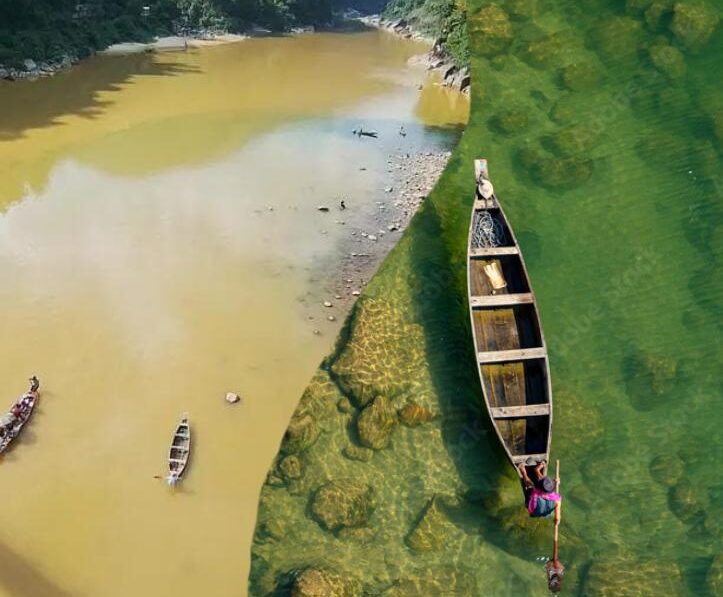
It is profoundly disturbing to witness the once crystal-clear waters of the Umngot River turn a murky brown. This unsettling change raises a pressing question: Is tourism truly sustainable in Meghalaya? The Umngot, celebrated across India for its transparent, crystal-clear waters during the winter months, has suddenly turned muddy and brown. According to local authorities, the cause lies in the ongoing widening of the Shillong–Dawki road by the National Highways and Infrastructure Development Corporation Limited (NHIDCL). Allegations have surfaced against NHIDCL for recklessly dumping soil and debris from construction sites into nearby rivers, including the Umngot. Yet, the issue goes beyond the immediate pollution of one river. It reflects deeper structural problems- most notably, the unchecked expansion of the tourism industry in Meghalaya and the environmental degradation it increasingly leaves in its wake.
Meghalaya attracts an increasing number of visitors every year, with tourism emerging as one of the most booming sectors contributing to the state’s gross domestic product. In 2024 alone, around 1.6 million tourists visited Meghalaya, a remarkable figure compared to other states in Northeast India. The government has actively promoted Meghalaya on a global stage though advertisements and sponsorships, projecting the state as a destination of beautiful, picturesque landscape and cultural richness. Meghalaya’s unique matrilineal culture is a significant draw for visitors seeking a different cultural experience. The locals maintain strong ties to their traditional customs, despite of the fact that most of the population are Christians. These factors strongly contributed to attracting visitors to the state. This has in turn benefited the economy by generating livelihood opportunities for the local populace, but it also raises an urgent question: for how long can this growth remain sustainable? The unplanned and unregulated boom in tourism poses serious risks to both the environment and the cultural fabric of the region. The lack of effective regulatory mechanisms has led to growing concerns about waste management, traffic congestion, the maintenance of cleanliness at tourist sites, and the preservation of ecologically and culturally sacred spaces. Meghalaya’s environment is exceptionally fragile, and its cultural heritage deeply intertwined with the land. Without thoughtful regulation and sustainable planning, the unchecked influx of tourists could ultimately undermine the very beauty and authenticity that make Meghalaya so appealing.
Furthermore, the region’s sensitivity extends beyond its fragile environment to its rich and diverse cultural landscape. The absence of strict regulatory mechanisms not only exposes the environment to degradation, but also threatens the delicate balance of local traditions and ways of life. Meghalaya is home to a vibrant tapestry of cultural practices- such as the matrilineal social system, the conservation of sacred groves, distinctive land tenure systems, and festivals like Shad Suk Mynsiem, Behdeinkhlam, and Wangala. These traditions reflect deep connections between people, land, and spirituality. However, the growing pressures of tourism, amplified by the forces of globalization and neoliberal development, raise critical questions about the sustainability of both the environment and culture. How long can Meghalaya preserve its ecological integrity and cultural authenticity amid the unregulated expansion of tourism? When we talk about sustainability in this context, it must go beyond its conventional understanding of mere environmental preservation. Sustainability should instead encompass the social, economic, and cultural dimensions that together shape a community’s way of life. Leo Howe, in his book The Changing World of Bali: Religion, Society and Tourism, argues that the erosion and decline of Balinese culture were direct consequences of unsustainable tourism practices. The influx of visitors and the uncritical embrace of tourism-driven development left local communities in a state of cultural disorientation, alienated from the authenticity of their own traditions.
The contamination of the Umngot is not an isolated incident but a manifestation of human infrastructure projects failing to coexist harmoniously with the natural world, an imbalance Latour would interpret as a breakdown in the network of relationships among human and non-human actors.
Tourism, therefore, should not be guided solely by economic imperatives. Rather, it must seek a balance between economic gains and cultural values, ensuring that one does not outweigh or undermine the other. The core idea behind promoting eco- and cultural tourism in Meghalaya should not be to exploit the state for tourism, but to harness tourism for the sustainable development of Meghalaya and its people itself. Historically, the people of Meghalaya have shown remarkable hospitality, welcoming individuals from diverse walks of life. Yet, culture while resilient is inherently fragile in the face of unchecked tourism.
The tragedy that unfolded in Bali, where mass tourism disrupted religious practices, artistic traditions, and local identities through cultural commodification, serves as a cautionary tale. Similar outcomes could emerge in Meghalaya if cultural expressions are transformed into marketable spectacles. The commodification of culture often produces unforeseen consequences, altering the community’s self-perception as well as the way outsiders view its identity. While some may argue that Meghalaya, though culturally and ecologically rich, remains economically poor and thus stands to benefit from tourism, such an argument risks justifying the exchange of cultural integrity and ecological balance for economic profit. True sustainability demands that economic development proceed hand in hand with the preservation of the region’s cultural and environmental heritage.
It is crucial to examine the growing pressure that tourism exerts on Meghalaya’s fragile environment. The state government’s extensive promotion of tourism, without a corresponding structural framework to manage the influx of visitors, has led to an unregulated flow of tourists that impacts not only the culture but also the ecology. Tourism demands intensive use of land and water resources, and the rapid proliferation of homestays, hotels, and other infrastructure reflects the large-scale transformation of land to meet industry needs. This is particularly concerning given that Meghalaya and the Northeast is an ecologically sensitive region. The swift pace of infrastructural development in such areas affects both human and non-human actors, disrupting delicate ecological balances.
These infrastructures also carry different meanings and narratives for various stakeholders; however, the core concern lies not in these narratives, but in their cumulative environmental impact. Drawing on Bruno Latour’s Actor-Network Theory (ANT), one can understand that non-human entities, such as rivers, forests, and soil are not passive objects but active participants within interlinked networks. In this sense, the environment is as alive and responsive as we are, and so is the Umngot River. The contamination of the Umngot is not an isolated incident but a manifestation of human infrastructure projects failing to coexist harmoniously with the natural world, an imbalance Latour would interpret as a breakdown in the network of relationships among human and non-human actors. Many such disruptions in this ecologically delicate region likely go unnoticed, quietly producing long-term harm. As a result, the sustainability of both tourism and the environment in Meghalaya remains deeply ambiguous.
the Sixth Schedule was constitutionally designed to protect the culture, land, and autonomy of tribal communities, the forces of globalization and neoliberalism have reframed land as an economic asset- an entity to be commodified and exploited for profit. In this context, exemptions and policy adjustments could easily be justified under the pretext of “development.”
The question of indigenous sovereignty in Meghalaya remains deeply contested. Supporters of the Sixth Schedule often take pride in its constitutional provisions, which are meant to safeguard indigenous lands and institutions, even after the insertion of Paragraph 12A. Conversely, opposing voices continue to advocate for revisiting the Instrument of Accession and Standstill Agreement in order to restore the authority of traditional institutions such as the rule of the Syiems. Yet, the discussion here highlights the inherent limitations of this form of sovereignty granted to indigenous communities. With the advance of neoliberalism and globalization, these limitations can be and often are manipulated by the state to serve its economic interests, particularly through the expansion of tourism.
It comes as little surprise that investors from outside the region increasingly view Meghalaya as a lucrative destination for capital investment in the booming tourism industry, promising ever-growing profits. I recall an instance during my time in a coaching class in Shillong, when a teacher from outside the Northeast remarked that Sohra (Cherrapunjee) would develop much faster if the Sixth Schedule were lifted from that area, thus allowing the market to flourish and the economy to expand through so-called “developmental projects.” This comment reflects a troubling paradox: while the Sixth Schedule was constitutionally designed to protect the culture, land, and autonomy of tribal communities, the forces of globalization and neoliberalism have reframed land as an economic asset- an entity to be commodified and exploited for profit. In this context, exemptions and policy adjustments could easily be justified under the pretext of “development.” Land, as the foundation of indigenous identity and livelihood, is also the indispensable resource at the heart of the tourism industry, making its control and ownership central to the larger political economy of Meghalaya’s development.
It is imperative for the state government to formulate comprehensive policies that address not only the influx of visitors and tourists but also the question of who truly benefits from the tourism industry. These policies must, unequivocally, prioritize the interests and rights of the indigenous communities. In recent years, Meghalaya has witnessed troubling instances of tourists desecrating sacred sites of worship acts that deeply wound the spiritual sentiments of local believers. This underscores the urgent need for a clear and enforceable framework: a set of standard operating procedures and policies that treat culture and tradition as sacred entities to be protected, rather than commodities to be commercialized.
It is vital to remember that every ecosystem and community has its own limit and carrying capacity. The state must therefore critically assess whether accommodating large numbers of tourists, particularly during festival seasons is sustainable in the long run. More fundamentally, there is a need to reimagine our relationship with the environment: not as a passive resource or a site for profit-making, but as a living entity deserving respect, reciprocity, and care.