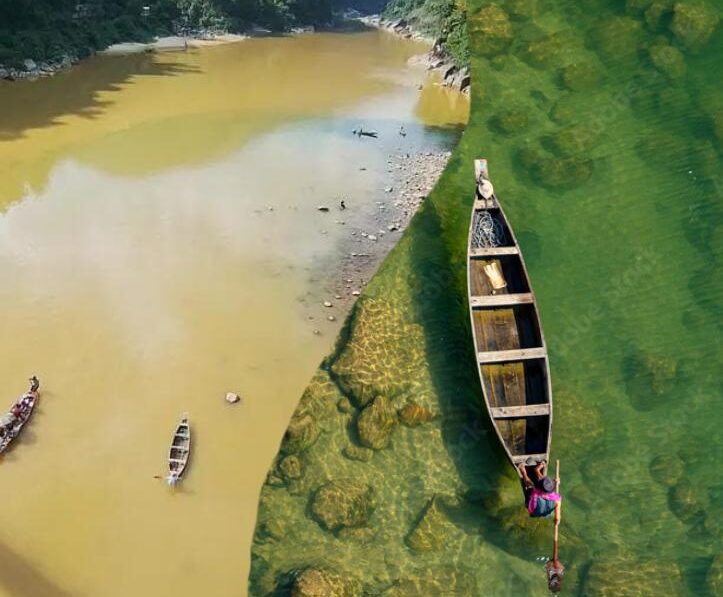
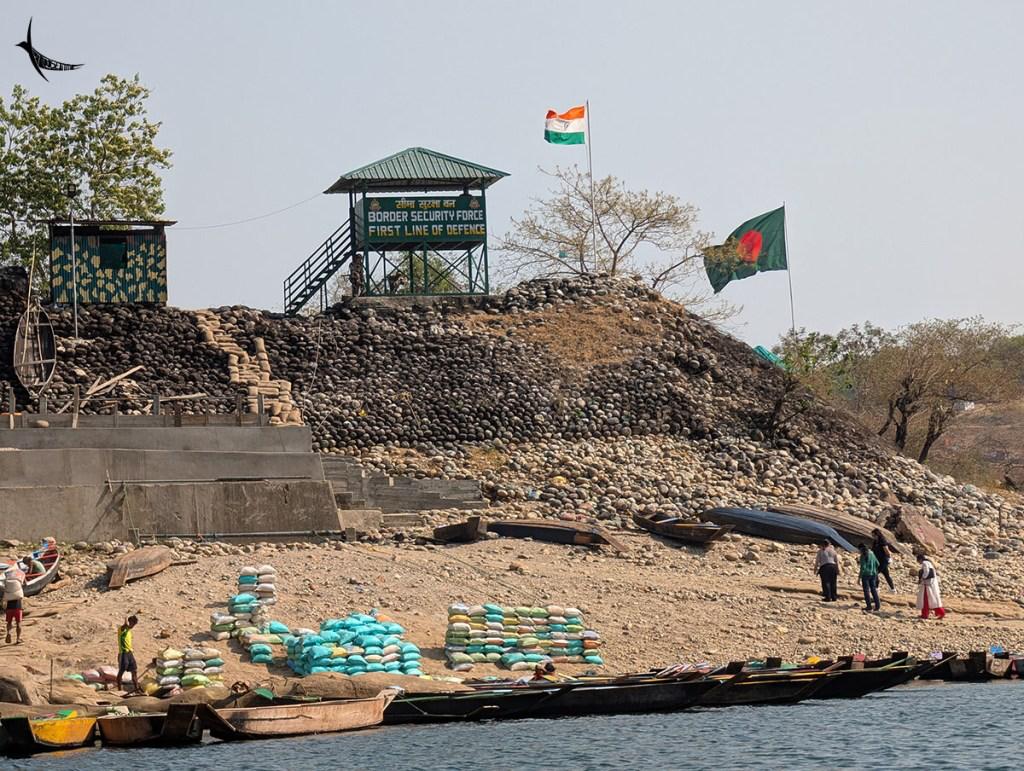
The current border between India and Bangladesh did not exist during the colonial period. At midnight on 14th August 1947, an invisible dotted line divided people’s homes, farms, and rivers, leaving people confused about their identities and nationalities. The 1947 partition deeply affected the lives of border residents and influenced the relationship with the neighbouring country. Even after partition, the border was not strictly guarded, and people often crossed it for social and trade reasons. The three main tribes in Meghalaya- Khasi, Jaintia, and Garo- also live just across the border, fostering strong ties among these communities.
In the post-World War II era, numerous states adopted the Westphalian system, embracing the concepts of sovereignty, clear territory, and defined borders. The state-centric ideology views borders as sites that constantly need defence and protection from external threats. To reinforce sovereignty and fully enclose their territories, borders have gained new importance as spaces for expressing sovereignty. Consequently, the construction of walls and fences signifies the enclosure of the state’s territory. In India, border fencing began in the 1980s along the India-Pakistan border, followed by fencing along the India-Bangladesh border in the late ‘80s. The prevalent narrative of illegal immigration in Assam’s valley led to calls for the complete fencing of the Assam-Bangladesh border in the 1960s. However, the plan was not implemented; the movement in the ‘70s and ‘80s against infiltration and illegal immigration from Bangladesh- fearing demographic changes- prompted the Government of India to approve border fencing in 1986, citing it as a means to prevent illegal infiltration and manage influx, alongside other legal measures.
The fencing process in Meghalaya started in 2000 in its second phase. However, it progressed slowly because land had to be acquired from locals and permissions had to be obtained from traditional institutions and the district council. Sometimes, construction halted due to disputes over the demarcation of guidelines, such as the requirement under the 1974 Land Boundary Agreement that fencing be built 150 yards from the zero point of Indian territory. These disputes delayed progress. Nevertheless, in early 2026, the Meghalaya Chief Minister stated that most of the fencing was completed, with only a 30-40 km stretch of the border remaining incomplete.
Mc Duie Ra1 elucidates that the narratives depicting the fencing of the India-Bangladesh border in Meghalaya are centred around (i) national security, (ii) monitoring trade, and (iii) infiltration at the national level. Fencing this border was seen as a logical step to strengthen national security and prevent the cross-border movement of terrorist and insurgent groups. Moreover, it was argued that fencing would help monitor the flow of both licit and illicit goods across the border and curb illegal trade and smuggling, which are entrenched in this space. On the contrary, “infiltration” was a term that frequently appeared in the discourse of border studies and border management in India and Bangladesh. Although this word is seemingly invoked in the context of Assam’s history, in recent decades, a noticeable shift has occurred in the fencing narrative in Meghalaya. It is important to shed light on “infiltration”. Schendel stated, “In Assam, the then-narrative of ‘homecoming’ during partition was replaced by ‘infiltration’ of the Bangladeshi Muslims in the subsequent decades2. Furthermore, in Meghalaya, the discourse on ‘infiltration’ was seemingly not debated until border fencing emerged as a hardening process of the India-Bangladesh border. Nonetheless, at the outset of border fencing, local pressure groups were more concerned with the influx of non-tribals from within India (from other states) than with those from outside (from other countries), whether from Nepal, Bangladesh, or elsewhere.
However, in recent years, this narrative has reemerged, with fears that Meghalaya would become a halting point for unlisted individuals seeking to avoid the rollout of the National Register of Citizens (NRC) and the Citizenship Amendment Act (CAA). At this critical juncture, pressure groups emphasise the need to implement the Inner Line Permit (ILP). The Meghalaya Legislative Assembly passed a resolution on ILP in 2019, following protests against the implementation of the Citizenship Amendment Bill (CAB), which subsequently received the President of India’s approval and became law. Yet, ILP remains a distant goal for Meghalaya; instead, the government of Meghalaya promoted the Meghalaya Residents Safety & Security Act, 2016 (MRSSA), arguing that it can curb the influx by requiring all entrants to present their identity credentials at designated facilitation centres3. However, the Act was returned by the Ministry of Home Affairs (MHA) to the state government, and the Meghalaya High Court noted that certain provisions in MRSSA were omnibus in nature and lacked specific parameters, leading to the closure of the entry-exit gates4. Nevertheless, the Chief Minister of Meghalaya asserts that MRSSA would help curb illegal immigration. Furthermore, the government narratives that focus on illegal immigration from any country are similar to the national narratives. On the contrary, pressure groups repeatedly emphasise that the influx involves non-tribal individuals from various locations both inside and outside India, a point that differs from the national narratives.
In a nutshell, the state government’s stance on border fencing shows initial, ambiguous, tacit support that evolves, much as the central government’s grand narratives do. Additionally, since the early 2000s, former Meghalaya Congress Chief Minister Dr D. D. Lapang has emphasised the need for fencing along the India-Bangladesh border and has occasionally warned against the NGO-led movement opposing fencing5. When delivering a speech at the 52nd National Development Council meeting in 2006, Dr Donkupar Roy highlighted the potential impact of fencing on the livelihoods and economic activities of border villages. He called for enhanced infrastructure and livelihood support for these areas6. In an interview with Tehelka, Indian News magazine, former Garo MP Agatha Sangma expressed her stance, emphasising that the fence could disrupt kinship ties among border villagers. She cited the visceral kinship relations among Garo communities across the border, which date back to a time before formal state borders or fences7. The partition based on religious lines was contrary to the indigenous Khasi, Jaintia, and Garo peoples, who were neither Hindu nor Muslim. Consequently, they bore the scars of partition, yet history seems to reframe itself from unfenced international borders to fenced state borders. However, the representatives’ narratives have recently evolved; for instance, Meghalaya’s Chief Minister Conrad Sangma reaffirmed that the government was actively working to complete the border fencing to prevent illegal immigration, mentioning only 30- 40 km remaining to be fenced8. These shifts in narrative reflect broader national discourse and reveal the government’s financial dependence on the central authority9, as opposition could jeopardise its position. The issue of influx in Meghalaya has been linked to illegal immigration or infiltration, with the government advocating for strong mechanisms to control it. Local pressure groups insist that this influx involves non- tribal outside the state and country, and consistently demand an Inner Line Permit (ILP) to protect their culture, traditions, and identity. However, the government, concerned about ‘immigrants’, supports the MRRSSA, which is completely indifferent to the pressure groups.
It is essential to understand the viewpoints of local pressure groups on the construction of border fencing. These groups do not see the border fencing solely as a tool to prevent the influx of migrants. As mentioned earlier, they often express support for ILP. However, they are concerned about the standard guidelines outlined in the 1974 Land Boundary Agreement, which stated that the fence shall be built within 150 yards of the zero point towards Indian territory. They fear that erecting fencing at this distance could dissect a significant portion of agricultural lands. Additionally, some villages are located near the zero point, such as Lyngkhong, Lyngkhat, Muktapur, and Dawki. According to the guidelines, this would mean the fence could cut off large parts of these villages. For example, Lyngkhong is a small village in the remote foothills of East Khasi, in the Pynursla Civil Subdivision, near the zero point of the India-Bangladesh border. The village had no access to electricity and relied on solar energy for lighting. If the fence is extended into this area, the entire village would end up outside it. In response, the village Dorbar has unanimously raised the issue with the relevant authorities to find a suitable, effective solution for the villagers. Similar concerns are present in Lyngkhat and Muktapur. Under the Land Boundary Agreement, Lyngkhat’s football field and graveyard would be lost, and Muktapur would lose its football field and residents’ houses as well. The villagers are also disappointed that compensation was provided only for the six-foot-wide patch of land where the fence is built10. Moreover, land is always linked to community identity; it sustains community life. Therefore, local pressure groups strongly oppose the construction of fencing within 150 yards, citing the loss of tribal lands, and urge the government to build at the zero point. For instance, in January 2026, an incident occurred in War Jaintia (in Muktapur, Sankhat) of Amlarem block, West Jaintia Hills, where the fence was not built according to the prescribed guidelines from the zero-point (pillar no.1301)11; it extended beyond 150 yards without informing or consulting the landowners and local institutions. The local people raised their voice, saying it would affect their lands, especially their areca nut and betel leaf farms, which are the primary sources of their livelihoods. The concerned landowners and village representatives from the affected areas urged the government to reconsider conducting a new survey to prevent massive land and livelihood losses.
Wastl- Walter12 wrote that borders manifest in countless forms and serve diverse roles and functions. They can be both tangible and intangible, appearing as fences, walls, doors, or even highly militarised border guards. This reflects the multifaceted nature of borders: for some, walls or fencing are security measures; for others, they may obstruct mobility across space. This echoes the concern raised by a former Member of Parliament (MP) from Garo Hills- that people living in the Meghalaya borderland share a visceral kinship across the border. This deep- rooted connection dates back centuries, before the modern concept of state borders existed. To be precise, the Khasi- Jaintia and Garo communities have lived in the plains of Bangladesh for centuries, and their presence remains vibrant today. Their identity, culture, practices, and traditions remain intact. The Land Boundary Agreement aims to strengthen the border by building fences along the India-Bangladesh border, exemplifying the state’s strong will and, as Scott13 mentions, to canalise the ‘enclosure of the border’ and mark a clear demarcation. However, indigenous people living in the borderlands unwittingly bear the consequences of political decisions made from the centre. From the scars of the partition in 1947 to the Liberation War of 1971, border residents have suffered, become marooned, and found themselves in a state of uncertainty. Therefore, it is crucial to listen to voices from the periphery rather than relying solely on traditional top-down approaches. The border is not merely a dotted line but a relational space with a long history of kinship, trade, and economic ties. Many indigenous communities reside on both sides of the border. We need an innovative, suitable solution to strengthen their relations rather than severing their longstanding social and economic bonds. It is essential to understand that the borderland is a zone of interaction where people on both sides share values, beliefs, feelings, and expectations, underscoring their interconnectedness. These indigenous communities have endured enough hardships because of the partition. Their voices deserve to be heard prominently, rather than marginalised. Their plight must be acknowledged and addressed by bringing them to the negotiation table and reversing the usual top-down decision-making process.
References
1.McDuie-Ra, D. (2014). The India–Bangladesh Border Fence: Narratives and Political Possibilities. Journal of Borderlands Studies, 29(1), 81–94. https://doi.org/10.1080/08865655.2014.892694.
2. Schendel, W. van. (2005). The Bengal borderland: Beyond state and nation in South Asia. Anthem.
3.https://theshillongtimes.com/2026/02/20/govt-to-amend-mrssa-2016-to-curb-influx-cm/
4.https://www.syllad.com/meghalaya-govt-to-amend-mrssa-as-per-centres-directive-cm/
5.https://www.telegraphindia.com/north-east/lapang-stalls-border-fencing-cm-hints-at-review-of-boundary-demarcation/cid/843036#goog_rewarded
6.https://www.oneindia.com/2006/12/09/massive-central-investment-in-physical-infrastructure-needed-dr-roy-1165674372.html.
7. Agatha Sangma in Vijay Simha, ‘Treat Northeast as a Special Zone, Even If You Lose Money’,Tehelka (online version) (2009), http://www.tehelka.com/story_main41.asp?filename=Agatha_Sangma.asp.
8.https://assamtribune.com/north-east/meghalaya-govt-working-aggressively-to-complete-bangladesh-border-fencing-cm-sangma-1604543.
9.https://theshillongtimes.com/2026/03/03/meghalaya-state-budget-no-road-to-financial-freedom-or-self-sufficiency/
10. Duncan McDuie-Ra (2012). Tribals, migrants and insurgents: security and insecurity along the India–Bangladesh border, Global Change, Peace & Security, 24:1, 165-182, DOI: 10.1080/14781158.2012.641286
11.https://youtu.be/LrGRhAbfzjU?si=kHuD1lEwQNKSbZqz. Byrthen Īa Um-Snam Ki Trai Bri Kwai | Thom Ka Company Ba Shna ‘Fencing’ Ïa Ki Jaka Ha Ri War Jaiñtia.
12. D. Wastl-Walter, ‘Introduction’, in D. Wastl-Walter (ed.), The Ashgate Research Companion to Border Studies (Farnham: Ashgate, 2011) p. 2.
13. Scott, J. C. (2009). The Art of Not Being Governed: An Anarchist History of Upland Southeast Asia. Yale University Press. http://www.jstor.org/stable/j.ctt1njkkx