Introduction
The development strategies of nations are primarily formulated and rooted in Western concepts of modernization. It is believed that projects are leading to development on a significant level. Nevertheless, massive dam developments serve as a steadfast representation of growth. Certain countries around the globe are making significant investments in building dams, primarily aiming to attain growth in the economy. The five most prominent nations in dam construction today make up almost 80% of large dams worldwide. Dams over 15 metres tall are classified as large dam projects according to the International Commission on Large Dams (ICOLD). Large dam construction is currently encountering significant obstacles due to concerns about environmental harm and substantial impacts. Movements and demonstrations opposing large dams are increasing in solidarity with campaigns led by different groups such as Environmental advocates, NGOs, impacted indigenous communities, and advocates for human rights. Construction of large dams can be evaluated within the scope of various state policies that are pertinent, such as the policy related to energy, the policy related to irrigation, the strategy for flood control, the policy regarding forests, the policy for the development of tribal communities, and more. In fact, the World’s 1st Anti-Dam Movement happened in India itself, in Pune, called Mulshi Satyagraha, which has been compiled into a book by Rajendra Vora called: The World’s First Anti-Dam Movement: The Mulshi Satyagraha 1920–1924.
The dams pose a danger to the farmlands along the Nyamjan Chhu and Tawang Chhu rivers, potentially depriving the farming community of their livelihood. The Monpa community only has these marginal farmlands left for cultivation, as they have already lost all their cultivable land due to previous land acquisition drives for defence settlements and district administration offices. The Monpa people were also worried that their small tribe, with only 60,000 members, could be eradicated by the arrival of migrant workers and other modernization processes linked to these projects
Anti-Dam Movements in Arunachal Pradesh
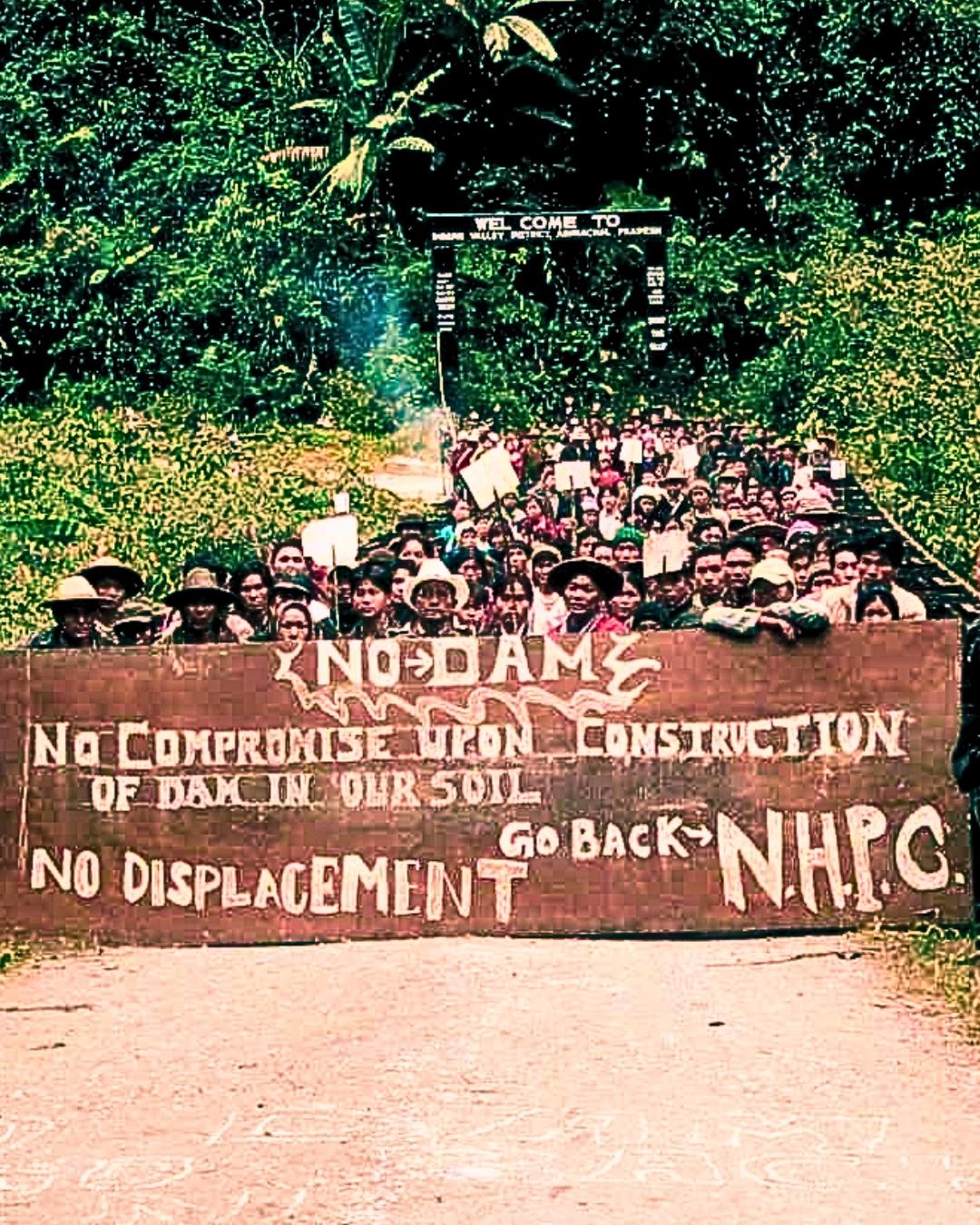
Under India’s National Hydro Power Policy, the state government intended to build 13 hydro-power projects in Tawang district to produce approximately 2900 mw of power. The majority of the hydro-power projects were planned for development in the main river basins in Tawang – the Tawang Chhu in the east and the Nyamjang Chhu in the west. The Bhilwara Energy Limited planned to build the Nyamjangchhu hydroelectric power project with 780 MW capacity at an estimated cost of around Rs 6852.28 crore, while the National Hydroelectric Power Corporation (NHPC) was set to build two large hydropower projects in Tawang District – Stage 1 and Stage 2, with capacities of 600 MW and 800 MW. Furthermore, other private companies had plans to construct 10 additional hydropower projects.
The formation of the Save Mon Region Federation (SMRF) in 2011 was initiated by the residents of Tawang, with leadership from the monks, to oppose the large hydroelectric power initiatives. The SMRF noted that these projects posed a significant danger to Tawang, a region known for its geographical volatility and high seismic activity. In addition to putting numerous sacred Buddhist pilgrimage sites at risk, the hydropower developments also posed a danger to the survival of the rare, black-necked cranes, revered as a sacred representation of the 6th Dalai Lama, and who have chosen Tawang as their winter residence. The dams posed a danger to the farmlands along the Nyamjan Chhu and Tawang Chhu rivers, potentially depriving the farming community of their livelihood. The Monpa community only has these marginal farmlands left for cultivation, as they have already lost all their cultivable land due to previous land acquisition drives for defence settlements and district administration offices. The Monpa people were also worried that their small tribe, with only 60,000 members, could be eradicated by the arrival of migrant workers and other modernization processes linked to these projects.
The SMRF-led opposition to the dam project was additionally upset by the absence of input from the public, which put their lives at risk. The initiative picked up speed when the government instructed the reconstruction of the 6 MW Mukto Shakangchu hydropower project, which collapsed within three months of being built, costing over 90 crores. The failure of the Mukto Shakangchu project had already raised worries about the risky building practices and instability inherent in these types of projects in the area. Therefore, the government’s directive to enhance the Mukto Shakangchu venture intensified the public’s opposition to hydropower projects. The SMRF anti-dam movement sparked a resistance that included various strategic methods to ensure the monks’ demands were met. Examining the closely organised resistance plan of the anti-dam movement provides valuable knowledge for peace efforts. Between 2011 and 2016, the SMRF’s opposition to hydropower dams experienced a positive path. On April 4th, 2012, Tawang experienced its inaugural peaceful demonstration, with thousands joining forces to oppose the development of large-scale hydropower ventures. As a result of this protest, an annual event began taking place in the valley each winter.
Right after the initial peaceful protest triumph, approximately 60 monks from the SMRF journeyed to Itanagar, the capital of Arunachal Pradesh, to build partnerships with like-minded activists. Subsequently, they proceeded to North Lakhimpur in Assam to make contact with activist and community leader Akhil Gogoi. Famous for spearheading the anti-dam movement and advocating for indigenous rights in Assam, Gogoi provided active guidance to the monks during the protest. Akhil Gogoi, Lobsang Gyatso, and other SMRF leaders connected with environmental attorneys in New Delhi. Well-known conservation advocate Neeraj Vagholikar assisted SMRF in collaborating with multiple organisations and legal forums in New Delhi.
The SMRF, represented by lawyer Ritwick Dutta, lodged a plea with the National Green Tribunal (NGT) challenging the environmental clearance granted to Bhilwara Energy Limited for the development of the Nyamjangchhu hydropower project. Following a four-year legal dispute, the NGT ultimately invalidated the environmental clearance in April 2016. The NGT ordered the Expert Appraisal Committee to carry out a new public appraisal using a new Environmental Impact Assessment, since the 2009 public consultation was found to have involved excessive police force and restricted input from the public. The NGT also ordered the Ministry of Environment, Forest, and Climate Change to carry out a distinct research project for safeguarding the habitat and preserving the black-necked crane with the help of the Wildlife Institute of India, Dehradun.
Following the submission of the petition, Punjab National Bank, which was financing Bhilwara Energy Limited, had already pulled out its financial backing for the project, leading to the company having to stop operations. In addition to the victory in the NGT case, a lawsuit for violating the Forest Conservation Act was lodged against two other mini hydel power projects named the 7.5 MW Kangteng Nalla hydroelectric project and the 3 MW Shyaro Nalla hydroelectric project at the Ministry of Environment, Forest and Climate Change. The Indian Ministry of Environment, Forest, and Climate Change also halted construction on two small power projects associated with the Nyamjangchhu hydroelectric power project. The topic of political power and the SMRF anti-dam movement has been fascinating, uncovering the various complexities within the movement. Following the signing of the agreement to halt construction on NHPC mega power projects in Tawang, Lama Lobsang Gyatso stepped down from the SMRF. Lobsang Gyatso was determined to participate in elections and gain political authority in order to address the hydropower projects in Tawang by obtaining a lasting solution through a democratic decision by the Gram Sabha, as per the Forest Rights Act (FRA). Afterwards, he would ask NHPC to leave Tawang for good and, if necessary, pursue legal recourse.
Gyatso was concerned that without a Gram Sabha resolution under the FRA, the community would be unable to advocate for their rights if the government reneged on their commitment to not build mega hydropower projects in Tawang. The community of monks was hesitant to gain political power and make the movement political, but they did end up submitting nominations against Pema Khandu in the 2019 assembly elections. The disagreement between the monks of SMRF and Lama Lobsang Gyatso caused him to step down from SMRF and join in political activities with Janata Dal (Secular). In the 2019 assembly election, Tawang experienced a three-way competition for the first time in more than twenty years, with Pema Khandu, the current chief minister of Arunachal Pradesh and Mukto Assembly seat holder in Tawang district, participating. Even though Lama Lobsang Gyatso was selected by Janata Dal (Secular), the Congress party selected another monk, Thupten Kunphen, to compete in the elections. Nonetheless, the monks failed to start their election campaign on time, and, along with limited funds, they were defeated by Pema Khandu in the election. The hydropower initiatives have continued to exist.
References
Dutta, Bitopi. The anti-dam movement in Arunachal. India Seminar, 2016. India Seminar, https://www.india-seminar.com/2020/732/732_bitopi_dutta.htm.
Mishra, Pradeepta. Anti-dam Movements and Disputes for Indira Sagar National Project (Polavaram). IJCRT, 2018. IJCRT, https://ijcrt.org/papers/IJPUB1801115.pdf.
Vora, Rajendra. The World’s First Anti-Dam Movement: The Mulshi Satyagraha, 1920-1924. Permanent Black, 2009. Accessed 31 October 2024.