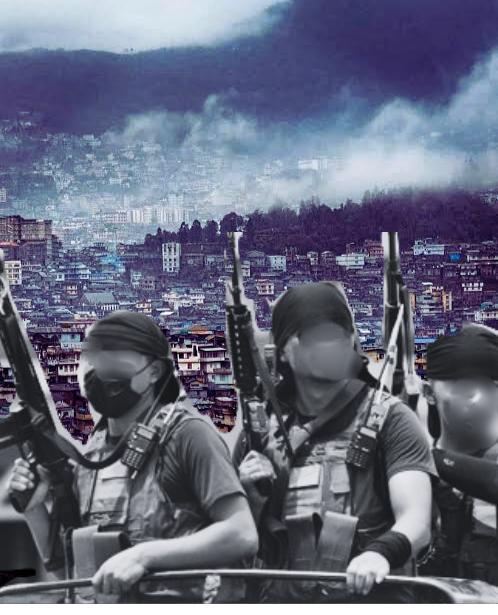
There has been considerable appreciation and celebration not just in mainstream liberal sections of media and critics, but also among audiences from the northeast who were able to see themselves, their idioms, their ways of being, on a couple of Indian popular web series lately. The appreciations converge on the fact that the series portray the northeastern parts relatively more ‘authentically’, unlike earlier attempts. The casting of actors from the region ensured that authenticity prevailed. The characters speaking in Nagamese and other languages, previously unheard of in mainstream screen, add another layer of novelty. The themes explored attempt to pierce through usual tropes and bring some nuance to the sociopolitical environment and relationship that Nagaland, Manipur, Assam, and the whole region continue to share with mainland India. Instances of casual racism experienced by people from the northeast at the hands of ‘ignorant’ mainlanders are also explored in humorous ways to arouse a sense of guilt among the urban middle classes. All this amounts to a comparatively better representation in terms of the hitherto ignored, misrepresented (remember the Bollywood flick Tango Charlie) realities of the region. And yet, we see on our Instagram feed a disturbing video in which racist slurs are thrown aggressively at three women from Arunachal in the National Capital Region, that too after hardly a month had passed when mainstream media discussed and debated the racist attack on a Tripura youth who succumbed to death in Dehradun. The slurs thrown were precisely the kinds that the ‘better’ representation wished to do away with. What lies beneath this contradictory attitude that the mainstream consciousness carries? Can there be an even better representation? Or are we in a representational aporia?
the mainland tourist gets the momentary experience of not so much what they seemingly ‘lack’ but what they intend to tame and freeze as souvenir within their tolerance.
Is Representation Neutral?
Some of the perspectives written about the sudden boom in representation are not entirely celebratory. Their perspectives, although acknowledging the subtlety with which the people, the lingo, and the environment have been treated in these series, have also criticized the subtle continuation of certain forms of power. The paternal relationship that persists between the center in the figure of the mainland protagonist, be it Hathiram Chaudhary, a Cop from Delhi, Vartika Chaturvedi, again a Cop from Delhi, and Srikant Tiwary, a spy in an organization modeled around NIA, and the periphery, the nebulous territory called the Northeast. Some very well point out this unequal relationship where the mainland protagonists suffer from what is known as the savior complex. In postcolonial lingo, a similar trope exists, the white savior trope that the ‘occident’ embraces, to manage and colonize or neo-colonize the ‘orient’. Put blatantly, one must revisit the Reagan-era Hollywood war flicks where a hyper-muscular Schwarzenegger or Stallone, batting for the Stars and Stripes, would sabotage ‘savage enemies’ of the Cold War era to save the local ethnic populace from the horrors of an abstract ‘authoritarianism’. Another criticism highlights how the northeast, although finding itself in a better representational frame, is always populated by an environment of imminent threat lurking in the background, typecasting and reducing the whole nebulous region to the trope of criminality arising from ‘incomplete’ political formations. Even after better representation, these narratives set up a gaze that ends up ghettoizing the northeast in very different ways. The answer lies not so much in an even better representation than in understanding the ideology of the very representation.
Celebrating Difference and Managing Participation
One quick Google search about the ‘Northeast and the Ott’ leads us to numerous news pieces from the Times of India to India Today, highlighting the sudden ‘boom’ in tourism in the Northeast. It is encouraging insofar as the local and small economies of the region, which are heavily dependent on tourism, can survive and thrive. However, one has to underline the fact that after the proliferation of vloggers in the Indian YouTube space, the region has reached a tremendous number of audiences who consume videos and reels ranging from ethnic/tribal food, the civil traffic, the politeness of the people, the sacred forests, the tribal costumes and customs, and so on. All things that the mainland seemingly lacks. The mainland tourist gets the momentary experience of things which are beyond their reach within their immediate surroundings and societies, one being the plethora of ethnicities celebrating their culture(s). Žižek explores multiculturalism as the cultural logic of late capitalism, where difference is superficially celebrated and consumed not necessarily to subvert racism but to keep the ‘other’ within the tolerance of the liberal subject. Whether or not the Indian subcontinent has a liberal subjectivity is a debate for another time, but the mainland does consume the northeast in a strikingly similar way. To put it in other words, the mainland tourist gets the momentary experience of not so much what they seemingly ‘lack’ but what they intend to tame and freeze as souvenir within their tolerance. This boom is symptomatic of a new sense of immediate connectivity that the internet, especially with YouTube and Instagram, has brought after the 4 G ‘revolution’ where differences are ubiquitously consumed on smartphones. Pre-4g era mainland subject consumed the ‘northeast’ through the mediation of the state, in Doordarshan, or in documentaries made for television, which spatially kept the subject and the object far away from one another, amounting to an ethnographic gaze. What has changed strikingly is not just that the spatial distance has decreased, but the gaze has transformed into a spectacular one, a kaleidoscopic gaze where difference becomes merely decorative. This new type of relationship (similarly, although in the context of postcolonial fiction in the global publishing market) is characterised, not by remoteness but by proximity, as Graham Huggans puts it in his book The Postcolonial Exotic (2001). This type of consumption is precisely mapped around the inclusion of Difference and exclusion of Participation.
Curating a ‘Palatable’ Northeast
One of the ways neoliberalism manages multiculturalism is by celebrating ‘ethnic’ music or food while strategically remaining silent on questions of resources. One must remember how indigenous communities continue to resist private corporations bypassing institutional mechanisms to grab protected land, while on the other hand, the states hold a variety of cultural festivals to celebrate ethnicities. In India, even ethnic food goes through multiple layers of inclusion and exclusion so that the final dish demonstrates difference but is also palatable enough for a certain urban middle-class/caste Hindu sensibility. While visiting Sohra in Meghalaya, we could only find restaurants serving vegetarian food, which wasn’t the case a couple of years ago. Local eateries coexisted along with restaurants that catered to vegetarian tourists, even though some would get uncomfortable while entering a local eatery that served chicken, fish, and mutton, let alone pork innards, beef chunks, jadoh, and tungtap. What has changed now is that the sight and smell of food that disturbs the tolerance of a particular subject has gone inside winding alleyways. The mainland tourist, this way, consumes culture from a safe distance, without having to do anything with the matter that makes that culture. Coffee without caffeine, beer without alcohol, as Žižek puts it, difference without authenticity or participation makes for a palatable ‘Northeast’, curated by and for the mainland.
The reduction of complex and protracted political issues to a trope of criminality itself unravels how the grammar of neoliberalism functions ideologically, even within ‘nuanced’ representation. For instance, the Naga issue, which is as complex as the Kashmir issue, if not more, is conveniently reduced to a simple ‘law and order’ theme. Corruption becomes the ‘palatable’ villain infesting the ‘northeast’ for the urban Indian middle classes instead of the very system which is present in absences.
Beyond Representation
It is in no way intended to criticise the relevance of difference; in a society like ours, where graded hierarchy persists even today, to assert difference is a step forward towards the disruption of that very hierarchy. In fact, it is a welcome change to see relatively ‘nuanced’ representation making it to Ott screens; however, it is not without its ideological aporia. The reduction of complex and protracted political issues to a trope of criminality itself unravels how the grammar of neoliberalism functions ideologically, even within ‘nuanced’ representation. For instance, the Naga issue, which is as complex as the Kashmir issue, if not more, is conveniently reduced to a simple ‘law and order’ theme. Corruption becomes the ‘palatable’ villain infesting the ‘northeast’ for the urban Indian middle classes instead of the very system which is present in absences. To put it simply, the representation encodes a specific type of exoticism which is symptomatic of a certain type of peripherality that continues to haunt the states and the people of the region vis-à-vis the mainland Big Other. The problem is not so much that the ‘northeast’ is being seen in crime thrillers and murder mysteries, but that it is being curated and consumed by a market where ethnicity and difference are mere commodities and hence, tokens of urban middle-class liberal tolerance. This tolerance of the mainland reduces differences to particularities while placing itself in the position of universality. To go beyond this conundrum is not to reject difference; it is to place those differences and particularities within the larger discourse of universality. It is to go beyond the ‘palatable’ northeast to push representation radically towards equal participation. It is to go beyond the commodification of ethnicities to arrive at questions of equal redistribution of resources and to assert difference as universal. Till then, we would keep celebrating characters from the regions resisting different manifestations of power in their respective region on screen, while reducing their identities to lesser human beings when they live right next to us. Is representation then not a certain kind of imposition till then?
